
a

Lorem ipsum dolor sit amet, conse ctetur adip elit, pellentesque turpis.

Image Alt

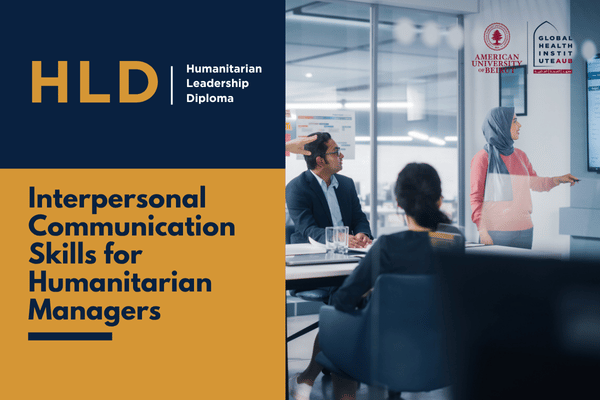
Interpersonal Communication Skills for Humanitarian Managers

Interpersonal Communication Skills for Humanitarian Managers

Interpersonal Communication Skills for Humanitarian Managers
Duration

Type

Language

Sector

Provider

Topic

$150.00

Enroll Now

Description

This course provides essential communication skills adapted for humanitarian and development settings, focusing on the unique demands of diverse, high-stakes environments. Participants will gain practical tools and techniques to improve communication effectiveness across a range of scenarios, from building trust with affected communities to leading resilient teams and managing cross-cultural interactions. Covering the full spectrum of interpersonal communication—from understanding cultural dynamics and active listening to crisis communication and conflict resolution—this course includes specialized topics such as empathy in crisis settings, ethical practices, digital communication, and continuous improvement. Through focused, topic-based modules, participants will learn to employ adaptive, ethically grounded communication strategies that support collaboration, enhance operational outcomes, and build a sustainable community relationships.

Learning Outcomes

  • Analyze interpersonal communication dynamics in humanitarian settings, including the influence of culture, identity, power, and context on meaning-making and relational outcomes.
  • Apply active listening, empathy, and emotionally attuned communication strategies when engaging with affected populations, colleagues, and stakeholders in high-stress and crisis environments.
  • Demonstrate adaptive verbal and non-verbal communication skills to build trust, manage difficult conversations, and support collaboration across culturally diverse humanitarian contexts.
  • Evaluate communication challenges and conflicts arising in humanitarian teams and field operations.
  • Select appropriate mediation, negotiation, and conflict-resolution strategies.
  • Employ clear, ethical, and psychologically informed communication practices during emergencies and crisis situations, including principles of psychological first aid and responsible information sharing.
  • Facilitate effective small-group communication and team interactions by applying inclusive leadership communication strategies that balance relational and task-oriented goals.
  • Critically assess the ethical implications of communication choices in humanitarian work, including confidentiality, representation, media engagement, and advocacy.
  • Utilize digital and remote communication tools strategically to support coordination, teamwork, and stakeholder engagement in humanitarian operations.
  • Assess and refine personal and organizational communication practices using feedback mechanisms and reflective evaluation to support continuous improvement and professional growth.


Target Audience

  • Humanitarian practitioners working with international and local NGOs, UN agencies, and civil society organizations
  • Project officers, field coordinators, team leaders, and supervisors engaged in community-based or emergency response work
  • Professionals working directly with affected populations, including refugees, displaced communities, and vulnerable groups
  • Early- to mid-career professionals seeking to strengthen leadership, teamwork, and communication competencies in high-stress settings
  • New entrants to the humanitarian sector seeking a structured foundation in interpersonal communication within humanitarian and development contexts

The course is appropriate for learners from diverse disciplinary backgrounds (e.g., health, social sciences, education, protection, project management) and assumes no prior formal training in communication, while supporting learners who wish to deepen and professionalize their existing practice.

User Registration

Reset Password