


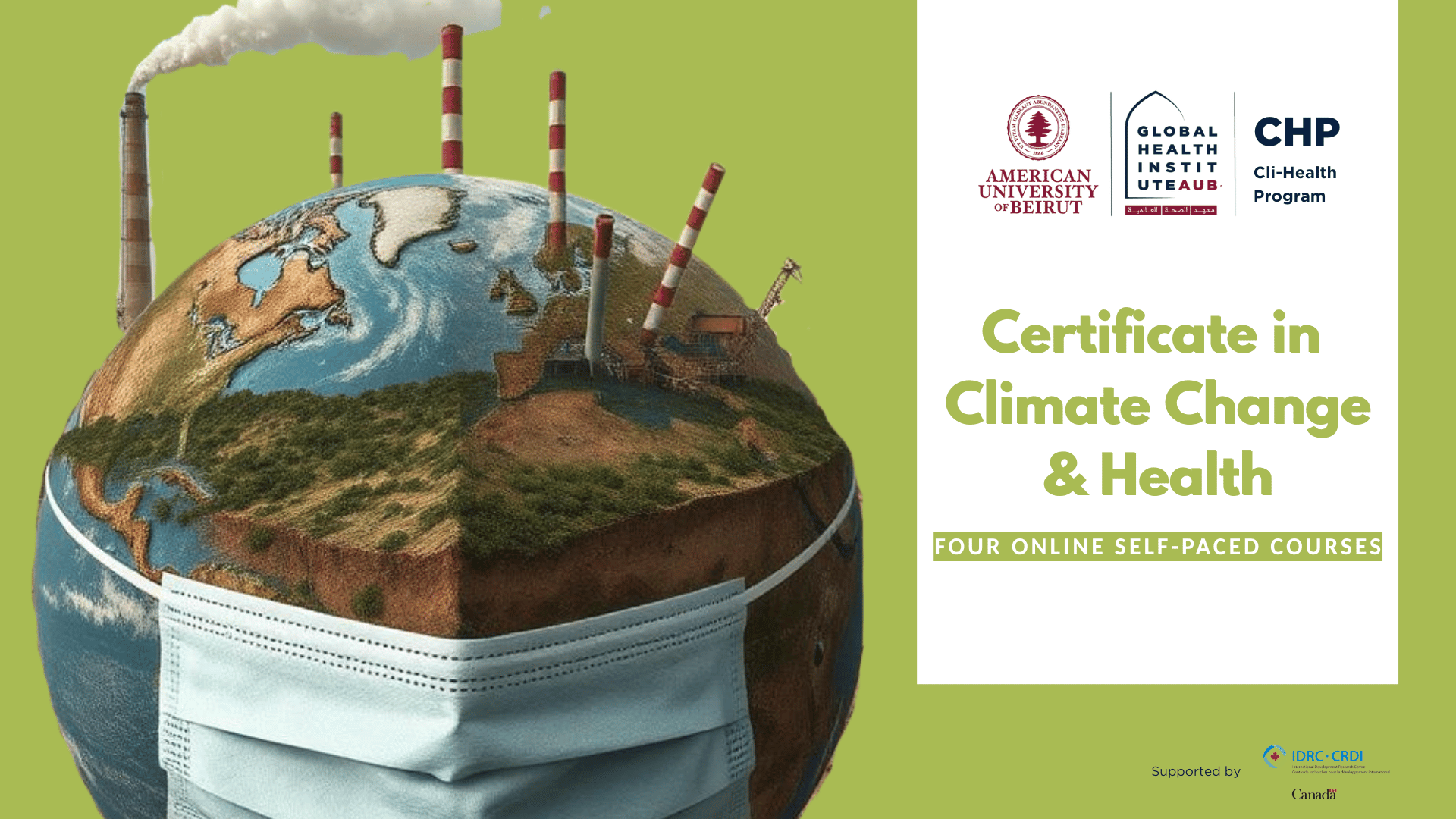
The Certificate in Climate Change and Health equips learners with the knowledge, analytical skills, and policy competencies to address the health impacts of climate change in the MENA region. Through four online asynchronous courses, the program bridges climate science, public health, and health systems thinking to explore how extreme heat, water scarcity, displacement, food insecurity, and climate-sensitive diseases affect population health and place increasing pressure on health systems, particularly in fragile and vulnerable settings.
Grounded in MENA case studies, the certificate combines conceptual foundations with applied tools, case-based learning, and policy-oriented approaches. Delivered through GHLAD, it offers flexible, self-paced learning for students and professionals. Upon completion, learners will be able to analyze climate-health risks, design equitable adaptation and mitigation strategies, and contribute to policy and health system responses that advance resilience and social justice in climate-affected contexts.
This course examines the impact of climate change on health, emphasizing approaches to enhance the resilience of healthcare systems and infrastructure in the Middle East and North Africa (MENA) region. Participants will explore how climate-driven challenges such as extreme heat, water scarcity, forced migration, and the rising burden of diseases disrupt healthcare delivery, strain medical infrastructure, and affect the well-being of healthcare workers. Through lectures and case studies the course focuses on strategies to strengthen healthcare systems, enhance adaptation efforts, and prepare for climate-induced emergencies. Participants will gain valuable knowledge about how to ensure the sustainability and resilience of healthcare systems amid growing climate pressures. By the end of the course, participants will be equipped with the knowledge and skills to support healthcare systems that can effectively respond to the challenges posed by climate change while fostering health equity and resilience across the MENA region.
This course provides an in-depth examination of the complex relationship between climate change and health, with a specific focus on the Middle East and North Africa (MENA). Designed to equip learners with a comprehensive understanding of climate science, health impacts, and adaptive strategies, this course brings the latest research and case studies from MENA to the forefront. The course is divided into three main segments: Climate Science Fundamentals, Health Implications of Climate Change in MENA, and Adaptation, Mitigation, and Policy. By exploring these themes, participants will gain a robust foundation in how climate shifts are uniquely affecting the health outcomes of communities in MENA and learn how global health approaches can proactively respond to these challenges.
This course focuses on developing practical skills in policy analysis, advocacy, and action for addressing climate change and health challenges in the MENA region. Learners will examine existing policy frameworks, develop advocacy strategies, and learn to craft effective policy recommendations. The course emphasizes practical approaches to influence policy decisions and promote integrated climate-health policies through evidence-based advocacy.
This course offers an in-depth exploration of the intersection between climate change, health, and social justice in the Middle East and North Africa (MENA) region. Learners will explore the concept of intersectional systems of inequality and discrimination, analyzing how these structures shape the disproportionate health impacts of climate change and related risks on vulnerable communities, assuming that groups might be impacted differently. It delves into the ways climate-induced challenges exacerbate health disparities, disproportionately affecting marginalized groups. Learners will engage in readings and activities focusing on marginalized and underrepresented populations, including women, refugees and migrants, minorities, low-income communities, Internally Displaced People, and People with Disabilities among others. The course adopts an interdisciplinary approach, combining insights and tools from environmental science, global health, social justice, gender and feminist studies, public policies, and human rights. While it incorporates global perspectives, the course remains rooted in the specific realities, priorities, experiences/history, and interconnected challenges of the MENA region. By the end of this course, learners will be equipped with the knowledge and tools required to establish a foundational knowledge on key concepts and understand the complex interplay between climate risks, health disparities, and social inequities. Learners will also be prepared to critically assess and engage with and contribute to climate-health initiatives and social justice movements that promote health equity and climate resilience in their communities.
Emerge with concrete strategies, an internationally recognized credential, and the practical skills to drive preparedness at your institution or ministry.
Examine the direct and indirect effects of climate change on health, including extreme heat, water scarcity, displacement, and climate-sensitive diseases.
Evaluate health system vulnerabilities and develop strategies to improve preparedness, adaptation, and response to climate-related risks.
Understand how climate change exacerbates health inequities and design inclusive, gender-sensitive approaches that protect vulnerable populations.
Build capacity to anticipate and respond to climate-related health emergencies and environmental shocks in fragile settings.
Assess climate and health policies and collaborate on developing evidence-based, community-driven solutions for climate adaptation and mitigation.
Enrollment is open year-round. Choose the full certificate or begin with a single course.
The Institutional Learning Package (ILP) is designed for organizations aiming to empower their teams through flexible, self-paced learning. It offers reduced fees for bulk registrations and provides institutions with real-time access to course progress metrics, enabling effective monitoring of learners’ progress.
Tailored capacity-building courses, workshops, and training offerings in the humanitarian, health and civil society sectors are available to meet the specific needs of organizations and institutions. These programs are co-designed to align with organizational priorities, operational contexts, and workforce development objectives. They may include adapted course content, blended learning formats, and customized training approaches, including language of instruction, delivery modality, and thematic focus.